Security Industry
Will AI Replace Security Professionals?
AI can watch cameras, detect intrusions, and analyze threats. But can it replace human judgment, de-escalation, and trust?
Partly. AI will automate monitoring, threat detection, and data analysis—reducing need for some security roles by 30-50% by 2030. But AI will not fully replace humans for: 1) Physical security requiring de-escalation, judgment, and presence, 2) Strategic cybersecurity analysis (threat hunting, incident response), 3) Trust-based security (executive protection, community policing). The role transforms: fewer monitors, more decision-makers.
Detection vs Judgment
AI excels at detection (seeing what's there). Humans excel at judgment (knowing what it means). Security needs both.
The De-escalation Problem
AI cannot calm a situation, read a room, or build trust. Physical security requiring human presence is AI-resistant.
Cybersecurity Paradox
AI creates more threats (AI-powered attacks) while automating defense. Demand for human cybersecurity professionals is growing, not shrinking.
The Verdict
Will AI Replace Security Professionals?
AI will replace 30-50% of security monitoring and data processing roles by 2030. But AI will not replace security professionals requiring human judgment, de-escalation, trust-building, and strategic analysis. The security industry will transform: fewer eyes on screens, more decision-makers. Cybersecurity is paradoxically growing—AI creates new threats, demanding more human experts.
2025 State
AI in Security Today (2025)
AI is already transforming security—but mostly as augmentation, not replacement.
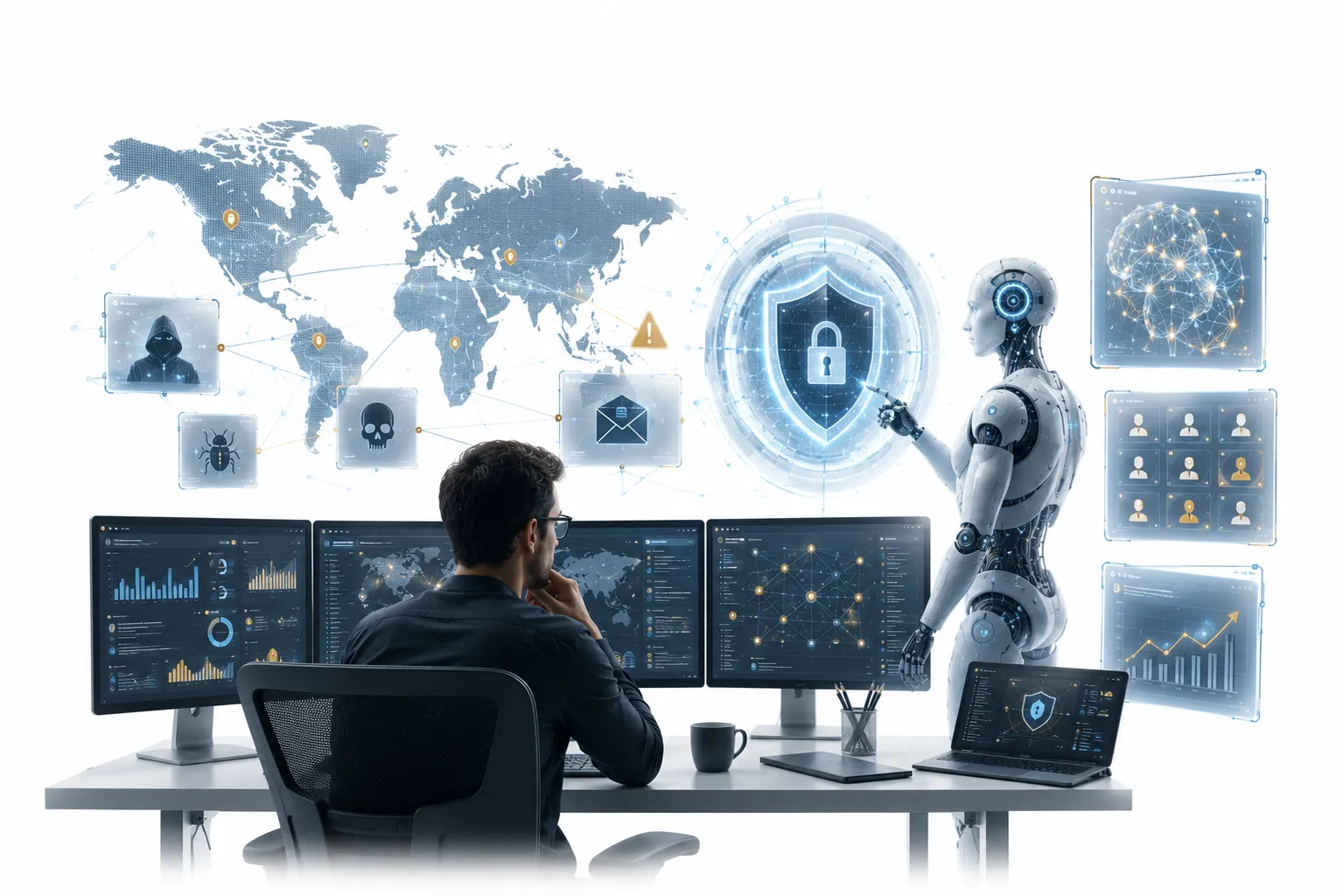
- Physical security: AI cameras detect weapons, intrusions, anomalies. Human guards investigate and decide.
- Cybersecurity: AI SIEM (Security Information and Event Management) analyzes logs. Human analysts triage alerts.
- False positives: AI detection has 15-30% false positive rate. Human judgment still essential.
- Labor shortage: Cybersecurity has 3.5M unfilled positions globally. AI isn't replacing—it's filling gaps.
- De-escalation: Zero AI systems deployed for de-escalation. This remains uniquely human.
- Trust gap: Surveys show 80% prefer human security for sensitive situations (executive protection, school security).
Evidence
What Research Shows
Studies on AI in security:
AI surveillance reduces monitoring need by 60-70%
Industry Data
False positive rates (15-30%) require human judgment
Scientific Study
Cybersecurity talent shortage growing (not shrinking)
Industry Data
De-escalation cannot be automated
Expert View
New security roles are emerging
Expert View
Risk Assessment
Security Roles by AI Replacement Risk
High, medium, and low risk roles
| Role | AI Replacement Risk | 2030 Outlook | Reason |
|---|---|---|---|
| CCTV Monitor | High (80%) | -60% employment | AI watches better, cheaper |
| Access Control (card checks) | High (70%) | -50% | AI/biometric automation |
| Log Analyst (entry-level) | High (65%) | -40% | AI SIEM automation |
| Patrol Guard | Medium (40%) | -20% | AI augments, human presence still needed |
| Threat Hunter | Low (20%) | +25% | Strategic analysis, AI augmented |
| Incident Responder | Low (15%) | +30% | Human decision-making critical |
| Executive Protection | Very Low (5%) | +10% | Trust-based, relationship-driven |
| De-escalation Specialist | Very Low (0%) | +15% | AI cannot de-escalate |
Reality Check
What People Get Wrong About AI in Security
Only monitoring roles. De-escalation, presence, judgment roles grow in value.
Talent shortage of 3.5M says otherwise. AI augments, doesn't replace.
False positive rates of 15-30% mean human judgment still essential.
They transform. Fewer monitors. More decision-makers.
Scenarios
Three Security Industry Scenarios for 2030
Optimistic: Human-AI Team
AI handles monitoring. Humans handle judgment, response, de-escalation. Security effectiveness improves. Jobs transform, not disappear. Wages increase for remaining roles.
Realistic: Uneven Transition
30-50% of monitoring roles eliminated. Some workers retrain. Some displaced. Cybersecurity grows. Wage polarization: high-skill security roles paid more, low-skill eliminated.
Pessimistic: Over-automation
Companies replace guards aggressively. AI surveillance with minimal human oversight. False positives cause incidents. Public backlash. Security effectiveness declines before recovering.
Future Outlook
Security in 2035
By 2028-2030, most monitoring will be AI-first. Human security professionals focus on intervention, de-escalation, investigation, and strategic analysis. Cybersecurity talent shortage persists.
By 2035, physical security roles split: low-skill monitoring eliminated, high-skill judgment/de-escalation roles expanded. Cybersecurity grows 15-20% despite automation. The human security professional is more valuable, not less.
Wild card: Could AI learn de-escalation? Currently no. But if AI achieves human-level social intelligence, the calculus changes. Experts say this is decades away—if possible at all.
Key Takeaways
What This Means for Different Groups
- For security guards: Develop de-escalation, judgment, relationship skills. Monitoring-only roles are dying.
- For cybersecurity professionals: AI is your friend. Learn it. Use it. Specialize in strategy, not just triage.
- For employers: AI + human is best. Don't over-automate. Judgment still matters. De-escalation still matters.
- For security students: Focus on psychology, communication, decision-making—not just cameras and software.
- For everyone: Security is becoming more human, not less. The human elements (trust, judgment, presence) are premium.
What Humans Do That AI Cannot
De-escalation: Calming a tense situation requires reading emotion, building rapport, showing empathy. AI cannot. Judgment: Knowing when to act, when to wait, when to call for backup. AI cannot. Trust: Building relationships with employees, tenants, community members. AI cannot. Physical presence: Deterrence requires human presence. AI cannot. These are not bugs—they're features of humanity. Security roles requiring these skills are AI-resistant.
Security Is Becoming More Human
The security guard who just watches cameras is being automated. The security professional who de-escalates, builds trust, uses judgment, and makes decisions is becoming more valuable. AI isn't making security less human—it's making security more human. The routine is automated. The uniquely human is premium. That's not a threat. That's an opportunity.
Guards, Cameras, Response
Physical Security: What AI Can and Can't Do
Physical security is a mix of monitoring (AI-friendly) and intervention (human-only).
WHAT AI CAN DO: Watch cameras 24/7 without distraction. Detect weapons, intrusions, unattended bags. Recognize faces (with bias concerns). Trigger alerts automatically. Log all activity. AI is exceptional at monitoring.
WHAT AI CAN'T DO: De-escalate a tense situation. Read a room's emotional temperature. Build relationships with employees. Use discretion ('that person looks lost, not threatening'). Call 911 and communicate with responders. Physically intervene. AI is terrible at judgment, context, and action.
THE RESULT: Security guards who just watch cameras will be replaced. Security guards who patrol, interact, de-escalate, and build relationships will be more valuable. The role transforms from 'watcher' to 'responder.'
Analysts, Engineers, Responders
Cybersecurity: The Paradox of AI
AI creates more threats while automating defense. Net effect: more cybersecurity jobs, not fewer.
AI-GENERATED THREATS: AI writes malicious code, generates phishing emails, automates attacks. The threat landscape is expanding faster than ever. More threats = more defenders needed.
AI DEFENSE: AI analyzes logs, detects anomalies, correlates events. This augments human analysts—handling volume, reducing alert fatigue. But AI has 15-30% false positive rate. Humans triage.
THE RESULT: Entry-level SOC (Security Operations Center) analysts who only triage alerts may see reduced demand. But strategic roles (threat hunting, incident response, security architecture) are growing. The cybersecurity talent shortage (3.5M unfilled) means AI is filling gaps, not causing unemployment.
High confidence
What Security Industry Leaders Say
AI will automate monitoring and data processing—reducing demand for entry-level security roles by 30-50%. But strategic, judgment-based, and de-escalation roles will grow. Cybersecurity is a growth field despite (because of) AI.
- Speed of transition (5 years vs 10 years)
- Whether new security roles will fully offset losses
- Impact on security guard wages (up or down?)
Analogy
The ATM of Security
Instead, tellers increased for 20 years. ATMs handled routine transactions. Tellers focused on relationships, problem-solving, cross-selling—higher-value work. Security is the same. AI handles monitoring (the routine). Humans handle judgment, de-escalation, trust (the high-value work). Not replacement—transformation. And transformation that makes the human role more valuable, not less.
Career Guidance
What If You're a Security Professional?
Move away from pure monitoring. Develop judgment, de-escalation, relationship skills. For physical security: become a responder, not just a watcher. For cybersecurity: specialize in threat hunting, incident response, security architecture—strategic roles AI augments but doesn't replace. Stay current on AI tools (you'll use them).
The worst response is denial. Monitoring roles are genuinely at risk. The best response is upskilling toward uniquely human capabilities.FAQ
Common Questions
Will AI security cameras replace human guards?
Replace monitoring. Not replace de-escalation, judgment, or presence. Mixed outcome: fewer watchers, more responders.
Is cybersecurity a good career given AI?
Yes. Talent shortage of 3.5M. AI creates more threats, demanding more defenders. Learn AI tools—you'll use them.
Should I become a security guard in 2025?
Only if you develop de-escalation, judgment, relationship skills. Monitoring-only guard roles are dying.
What security jobs are safest from AI?
Executive protection, de-escalation specialists, threat hunters, incident responders, security consultants. Anything requiring judgment, trust, or presence.
Sources
References
- AI in Physical Security ReportASIS International
- Cybersecurity Workforce StudyISC2
- Security MegatrendsSecurity Industry Association
Question journey
If this question matters, read these next
If you are worried about AI replacing jobs, most readers continue through this path.