Social Impact
Why Is AI Bad for Society?
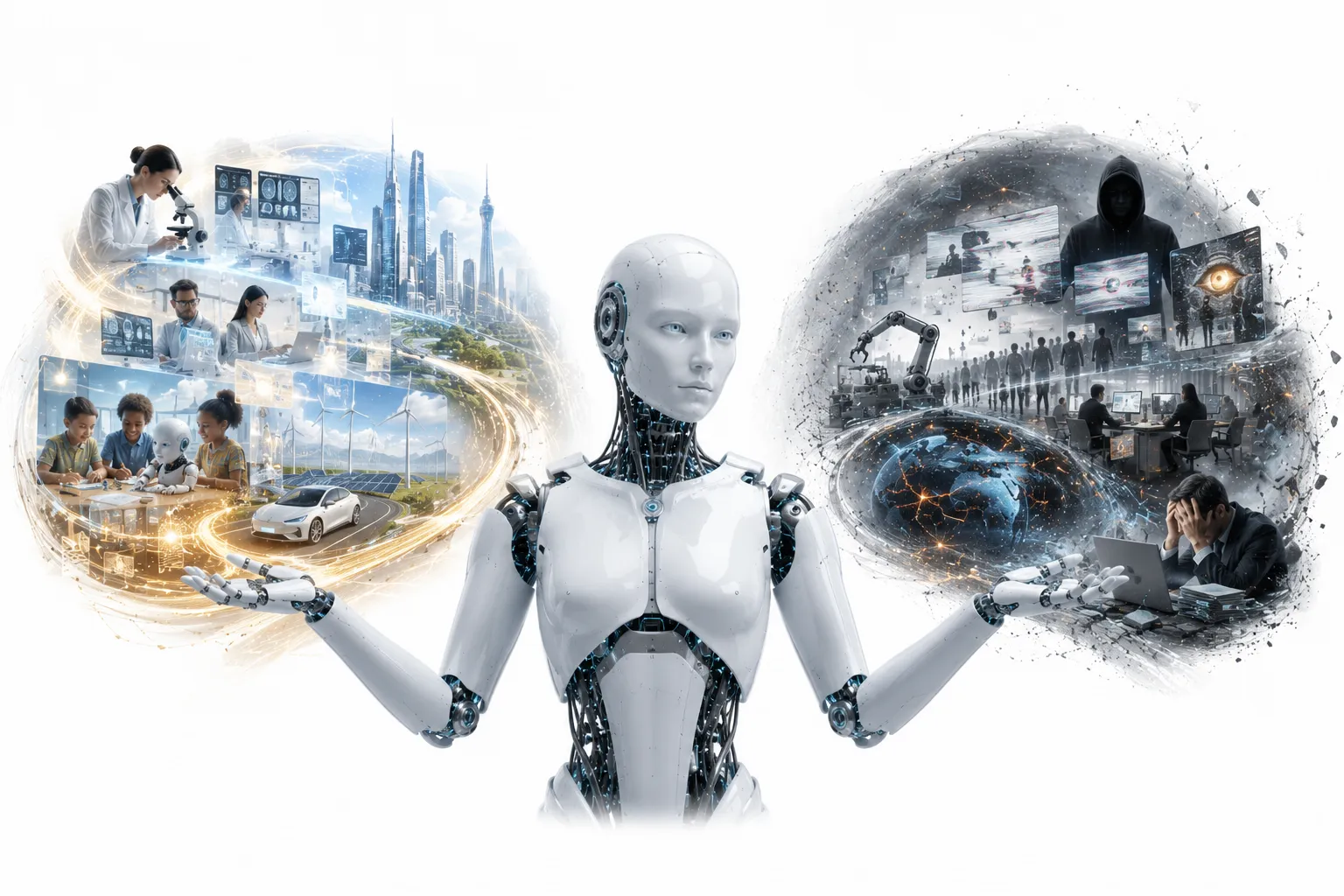
AI promises progress—but also threatens disinformation, inequality, job loss, surveillance, and social fragmentation. The dark side of the AI revolution.
AI harms society through: 1) Disinformation—deepfakes, AI-generated propaganda, erosion of trust. 2) Economic inequality—job displacement, wage suppression, wealth concentration. 3) Bias and discrimination—AI systems replicating and amplifying human prejudice. 4) Surveillance—mass monitoring, social credit systems, loss of privacy. 5) Social fragmentation—echo chambers, polarization, erosion of shared reality. 6) Psychological harm—addiction, loneliness, cognitive offloading. These harms are not theoretical—they're happening now.
Disinformation Crisis
AI generates convincing fake content at scale. Deepfakes are already disrupting elections, destroying reputations, and eroding trust.
Economic Inequality
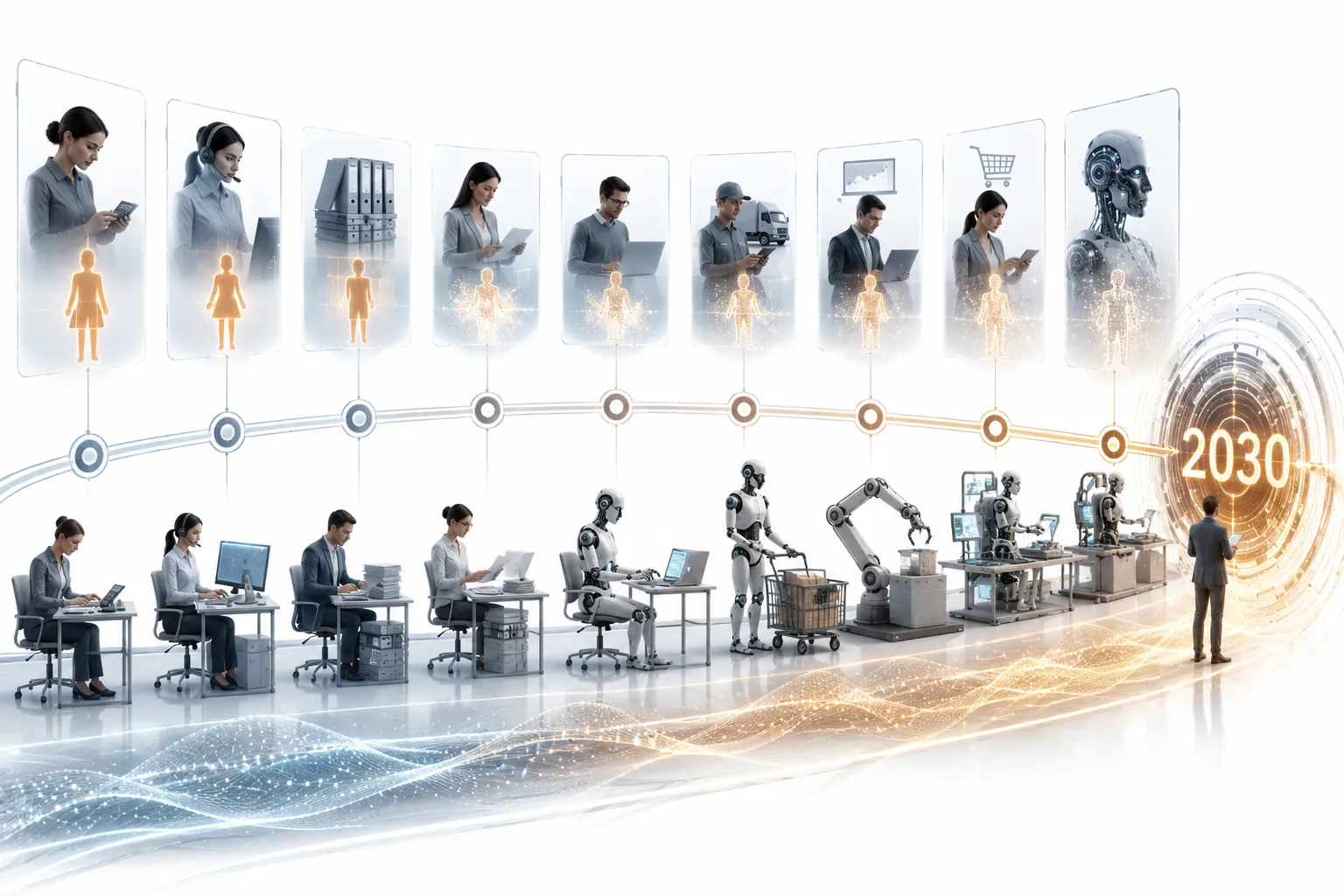
AI displaces workers, suppresses wages, and concentrates wealth among AI owners. The gap between rich and poor widens.
Surveillance Society
AI enables mass monitoring—facial recognition, behavior prediction, social credit. Privacy is dying.
The Verdict
Is AI Bad for Society?
AI is causing significant and growing harm to society: disinformation (deepfakes, propaganda, erosion of trust), economic inequality (job displacement, wage suppression, wealth concentration), bias and discrimination (replicating and amplifying prejudice), surveillance (privacy loss, social credit, control), and social fragmentation (polarization, echo chambers, loneliness). These harms are not inevitable—they result from choices about how AI is developed and deployed. But on the current trajectory, AI is making society worse, not better.
Reality Check
What People Get Wrong About AI and Society
False. AI concentrates wealth and power. The rich get richer. The poor get automated.
Regulation helps but is slow. AI moves fast. Harms outpace law.
Tools aren't neutral when wielded by the powerful. AI amplifies existing power structures.
Not automatically. Better requires action. Without action, AI harms will worsen.
Evidence
What Research Shows
Studies on AI's social harms:
Deepfakes influence elections
Scientific Study
AI hiring bias documented
Scientific Study
AI surveillance expanding rapidly
Industry Data
AI creates economic growth overall
Expert View
Regulation can mitigate harms
Expert View
High confidence
What Sociologists and AI Ethicists Say
AI is causing significant social harms: disinformation, inequality, bias, surveillance, and fragmentation. These harms are not inevitable—they result from choices. But on the current trajectory, AI is making society worse.
- Severity of harms (some say crisis, some say manageable)
- Whether benefits outweigh harms
- Effectiveness of proposed solutions
Solutions
What If We Want to Fix AI's Social Harms?
Individual: 1) Verify information before sharing. 2) Support AI regulation. 3) Advocate for ethical AI. 4) Maintain human relationships (don't replace with AI). Collective: 1) Pass deepfake laws. 2) Mandate AI bias audits. 3) Tax AI profits to fund retraining. 4) Strengthen privacy protections. 5) Invest in human connection (mental health, community). The future isn't predetermined. Action matters.
Time is short. AI harms are accelerating. Don't wait for others to act.Scenarios
Three Social Scenarios for AI by 2035
Optimistic: Regulated AI
Strong regulation (deepfake laws, anti-bias requirements, privacy protection). Harms mitigated. AI benefits shared more equitably.
Realistic: Uneven Outcomes
Some harms addressed (deepfakes). Others worsen (inequality, surveillance). Mixed picture. Society fragments further.
Pessimistic: Dystopia
Weak regulation. AI surveillance state. Mass disinformation. Extreme inequality. Democracy collapses. Social fabric destroyed.
Future Outlook
Society and AI in 2035
By 2030, expect more disinformation, more inequality, more surveillance. Harm will worsen before it improves. But also expect activism, regulation, and resistance.
By 2035, society will either have tamed AI (through regulation and ethics) or been tamed by AI (surveillance, control, fragmentation). The choice is ours.
Wild card: What if AI solves the problems it creates? AI could detect deepfakes, reduce bias, optimize resource distribution. AI may be both problem and solution. But waiting for AI to save us is dangerous.
Comparison
AI's Harms by Category
Summary of social impacts
| Harm | Current Impact | 2030 Projection | Who Suffers Most? |
|---|---|---|---|
| Disinformation | Elections influenced | Democracy at risk | Everyone |
| Job displacement | 2M+ jobs lost | 15M+ jobs lost | Lower-income workers |
| Bias/discrimination | Documented | Widespread | Minorities, women |
| Surveillance | 75+ countries | Global panopticon | Everyone |
| Social fragmentation | Polarization | Society broken | Young people |
Who Benefits from AI's Harms?
AI's harms aren't random—they benefit the powerful. Disinformation benefits politicians and propagandists. Job displacement benefits corporations (lower labor costs). Bias benefits existing power structures. Surveillance benefits authoritarian governments. Social fragmentation benefits engagement-maximizing platforms. AI is not neutral—it amplifies existing power dynamics. The winners are those who already hold power. The losers are the rest of us.
The Future Is Not Automated
AI is making society worse—disinformation, inequality, bias, surveillance, fragmentation. But these are choices, not inevitabilities. We built AI. We can shape it. We can regulate it. We can demand better. The future is not automated—it's chosen. Choose wisely. Choose justly. Choose human flourishing over machine efficiency. The AI future will be what we make it. Let's make it good.
2025 State
AI's Social Harms Today (2025)
AI harms are already visible—and worsening.
- Disinformation: AI-generated content influenced elections in 10+ countries (2024)
- Job displacement: 2M+ jobs lost to AI automation (2022-2025)
- Bias: Documented discrimination in hiring, lending, healthcare, policing
- Surveillance: 75+ countries using AI for mass monitoring
- Trust: Public trust in media at all-time low (20% decline since 2020)
- Mental health: AI-related loneliness and anxiety increasing
The Post-Truth Crisis
AI Is Killing Truth
Deepfakes, AI-generated propaganda, and fake content are destroying trust in reality.
DEEPFAKES: AI-generated video, audio, and images indistinguishable from reality. Deepfakes have: influenced elections (Biden robocall, 2024), destroyed reputations (fake porn), and caused panic (fake emergencies). Detection technology lags behind generation—30-40% of deepfakes go undetected.
AI PROPAGANDA: AI can generate thousands of plausible fake news articles, social media posts, and comments per minute. Propaganda at scale is now possible for pennies. Foreign interference has never been easier.
EROSION OF TRUST: When anything can be faked, nothing can be trusted. Public trust in media, government, and institutions has collapsed. The 'liar's dividend'—powerful people claim real evidence is AI-generated—further erodes accountability.
THE DEATH OF CONSENSUS: Without shared reality, democracy becomes impossible. AI is accelerating the fragmentation of truth.
The Wealth Gap
AI Is Making Inequality Worse
AI benefits the rich at the expense of the poor—widening the gap.
JOB DISPLACEMENT: 15M+ jobs at high risk by 2030—disproportionately affecting lower-income workers. Customer service, data entry, translation, paralegal—jobs that provided middle-class livelihoods are disappearing.
WAGE SUPPRESSION: Even workers who keep their jobs face wage pressure. AI makes every worker more productive—so companies need fewer workers. Surplus labor lowers wages.
WEALTH CONCENTRATION: AI profits flow to the already-rich—tech executives, shareholders, and AI company owners. The top 1% capture most AI-generated wealth. The bottom 90% see minimal benefits.
SKILL POLARIZATION: High-skill workers (AI engineers, data scientists) thrive. Low-skill workers struggle. The middle is hollowed out. The gap between AI-haves and AI-have-nots grows.
Algorithmic Discrimination
AI Replicates—and Amplifies—Human Prejudice
AI systems discriminate against race, gender, age, and disability.
HIRING BIAS: AI resume screeners discriminate against women (penalizing 'women's' colleges), minorities (names), and older workers (graduation dates). Amazon scrapped its AI hiring tool because it penalized women.
LENDING BIAS: AI credit scoring systems deny loans to minorities at higher rates—even when controlling for income. The algorithm 'learns' historical redlining.
HEALTHCARE BIAS: AI diagnostic tools underdiagnose Black patients, women, and minorities because training data lacks diversity. A famous algorithm required 'more sick' Black patients to qualify for the same care.
POLICING BIAS: Predictive policing algorithms send police to minority neighborhoods—because that's where past arrests occurred. The algorithm creates a self-fulfilling prophecy.
THE PROBLEM: AI doesn't create bias—it inherits it from human data. Then it amplifies it through automation and scale.
The Panopticon
AI Enables Mass Surveillance
Privacy is dying. AI is the executioner.
FACIAL RECOGNITION: AI can identify anyone in public—in real-time. China's social credit system tracks citizens' behavior, assigning scores that affect travel, loans, and jobs. Western countries are adopting similar surveillance.
BEHAVIOR PREDICTION: AI predicts your future behavior—whether you'll commit a crime, default on a loan, or quit your job. These predictions are often wrong—but used anyway.
SOCIAL CREDIT: Experimental social credit systems in China, UK, and elsewhere score citizens based on behavior. Low scores restrict access to services, travel, and employment. AI makes social credit scalable.
LOSS OF PRIVACY: In the AI era, privacy is a luxury. AI can infer sensitive information (health, politics, sexuality) from seemingly innocuous data. The panopticon is here.
The Divided Self
AI Is Fragmenting Society
AI-driven algorithms create echo chambers, polarization, and loneliness.
ECHO CHAMBERS: Recommendation algorithms show you what you already agree with. You never see opposing views. The result: radicalization, polarization, and the death of compromise.
POLARIZATION: AI-generated content pushes users to extremes—because extreme content is more engaging. The center cannot hold. Politics becomes warfare.
LONELINESS EPIDEMIC: AI companions (chatbots, virtual friends) replace real human relationships. Social skills atrophy. Loneliness increases—especially among young men and elderly.
EROSION OF EMPATHY: When AI does your customer service, your therapy, your teaching—you lose practice at human interaction. Empathy declines. Society becomes colder.
Analogy
The Industrial Revolution
Society responded: labor laws, unions, environmental regulations. AI is our Industrial Revolution. It brings progress—but also harms. The question isn't whether to have AI. The question is whether we'll respond—with laws, ethics, and collective action—or let the harms run unchecked. The Industrial Revolution taught us: progress without guardrails is exploitation. AI is no different.
Key Takeaways
What Everyone Should Know
- AI is causing real social harms—not theoretical risks.
- Disinformation, inequality, bias, surveillance, fragmentation—all worsening.
- Harms benefit the powerful at the expense of the rest.
- Regulation, transparency, and accountability can help—but action is urgent.
- Don't be naive: AI is not neutral. It amplifies power structures.
- Don't be fatalistic: Change is possible. But it requires effort.
- The future is not predetermined. It depends on choices made today.
FAQ
Common Questions
Is AI destroying democracy?
Potentially. Disinformation, surveillance, and polarization are threats. But democracy can survive—with regulation, media literacy, and civic engagement.
Will AI make inequality worse?
Yes—unless we intervene. AI concentrates wealth and displaces workers. Solutions include: AI taxes, universal basic income, retraining programs.
Can AI bias be fixed?
Partially—with diverse training data, bias audits, and transparency. But bias may never be eliminated. Regulation and oversight are essential.
Is surveillance inevitable?
No. Privacy laws, encryption, and activism can resist surveillance. But it requires collective action. Don't accept surveillance as inevitable.
Sources
References
- Deepfake Election Interference StudyMultiple research centers
- Automation and EmploymentBureau of Labor Statistics
- Amazon Scrapped AI Hiring ToolReuters
Question journey
If this question matters, read these next
Most readers use this path to move from the current question into the wider knowledge graph.