Medical Profession
Will AI Replace Doctors?
AI can detect cancers humans miss. It can diagnose from images. It can predict patient outcomes. But can it replace the human touch of medicine?
No for most specialties. AI will not replace doctors, but it will transform medicine. AI excels at diagnosis, pattern recognition, and data analysis. This threatens diagnostic specialties like radiology and pathology. However, AI cannot perform procedures, deliver bad news, or provide compassionate care. Surgeons, primary care physicians, and procedural specialists are safe. Radiologists and pathologists face the highest risk. The role of doctors will shift from diagnosis to integration, communication, and empathy.
Diagnosis Is Automatable
AI matches or exceeds human accuracy in radiology, pathology, dermatology, and ophthalmology. These specialties are at highest risk.
Procedures Are Safe
Surgery, endoscopy, and physical procedures require human hands. AI assists but does not replace.
Communication Is Human
Delivering bad news, building trust, and providing comfort are uniquely human skills. They cannot be automated.
The Verdict
Will AI Replace Doctors?
AI will not replace most doctors, but it will transform medicine. AI excels at diagnosis, pattern recognition, and data analysis. This threatens diagnostic specialties like radiology, pathology, and dermatology. These fields face 30 to 50 percent role reduction by 2030. However, AI cannot perform procedures, deliver bad news, or provide compassionate care. Surgeons, proceduralists, and primary care doctors who focus on communication are safe. The role of doctors will shift from diagnosis to integration, communication, and empathy. Medicine will become more human, not less.
2025 State
AI in Medicine Today (2025)
AI is already transforming medical practice, especially in diagnostics.
- Over 60 percent of hospitals use AI for radiology
- AI matches or exceeds human accuracy in cancer detection, retinal diagnosis, and dermatology
- Radiology reading volumes per doctor are up 30 percent (AI increases productivity)
- Radiologist hiring is flat to declining in some markets
- Pathology AI adoption is growing rapidly (digital pathology)
- FDA has approved over 500 AI medical devices
Evidence
What Research Shows
Studies on AI in medicine:
AI matches or exceeds human diagnostic accuracy
Scientific Study
AI plus human is best (augmentation)
Scientific Study
Radiologist roles are declining
Industry Data
Patients prefer humans for serious news
Survey Data
AI creates new medical roles
Expert View
Comparison
Medical Specialties by AI Risk
Risk and transformation by specialty
| Specialty | AI Risk | 2030 Outlook | Reason |
|---|---|---|---|
| Radiology | High (40-60%) | -30-50% roles | Image interpretation |
| Pathology | High (40-60%) | -30-50% | Slide analysis |
| Dermatology | Medium-High (30-50%) | -20-40% | Image diagnosis |
| Primary Care | Low-Medium (20-40%) | -10-20% | AI augments, human remains |
| Surgery | Very Low (<10%) | Stable | Physical procedures |
| Psychiatry | Very Low (<10%) | +15-25% | Mental health, human connection |
| Pediatrics | Low (10-20%) | Stable | Human trust essential |
Reality Check
What Doctors Get Wrong About AI
False. AI replaces diagnostic tasks, not doctors who provide care, empathy, and procedures.
For surgeons and psychiatrists, yes. For radiologists and pathologists, AI is a serious threat.
Doctors who ignore AI will be replaced by doctors who use AI. Adapt or fall behind.
No. AI makes mistakes, especially on edge cases and rare conditions. Human oversight is essential.
Scenarios
Three Medical Employment Scenarios for 2030
Optimistic: Augmented Medicine
AI handles routine diagnosis. Doctors focus on complex cases, procedures, and communication. Medical employment stable. Care quality improves.
Realistic: Diagnostic Reduction
Radiologist and pathologist roles shrink 30 to 40 percent. Primary care and other specialties transform. Total medical employment flat or slight decline.
Pessimistic: Diagnostic Extinction
AI replaces 60 to 80 percent of diagnostic roles. Radiologists and pathologists face mass displacement. Other specialties absorb some but not all.
Future Outlook
Medicine in 2035
By 2028 to 2030, expect AI to handle 50 percent of diagnostic work. Radiologist and pathologist roles will shrink. Primary care doctors will use AI for routine diagnosis.
By 2035, the doctor role will bifurcate. Diagnostic specialists will be AI augmented or replaced. Procedural and communication specialists will thrive. The human touch will be more valuable than ever.
A wild card: What if AI can perform surgery? If robotics and AI advance, even surgeons are threatened. Most experts say 20 plus years away, if possible at all.
Key Takeaways
What Every Medical Professional Should Know
- AI will not replace most doctors, but diagnostic specialties are at high risk.
- Radiologists and pathologists face 30 to 50 percent role reduction by 2030.
- Surgeons, psychiatrists, and pediatricians are safe. Procedures and human connection are AI proof.
- Learn AI tools. AI augmented doctors will replace those who ignore AI.
- Focus on human skills: empathy, communication, trust, and complex decision making.
- Consider specialty choice carefully. Diagnostic fields are changing dramatically.
The Radiologist Dilemma: Will AI Replace Reading Doctors?
AI matches or exceeds human radiologists at detecting cancers, fractures, and abnormalities. A 2024 study found that AI alone outperformed radiologists, and AI plus radiologist performed best. The implication: radiologists will not disappear, but fewer will be needed. AI increases productivity. The same volume of scans requires fewer readers. Radiologists must shift to interventional procedures, complex case review, and AI supervision. The era of the 'pure reading radiologist' is ending.
AI Diagnoses. Doctors Heal.
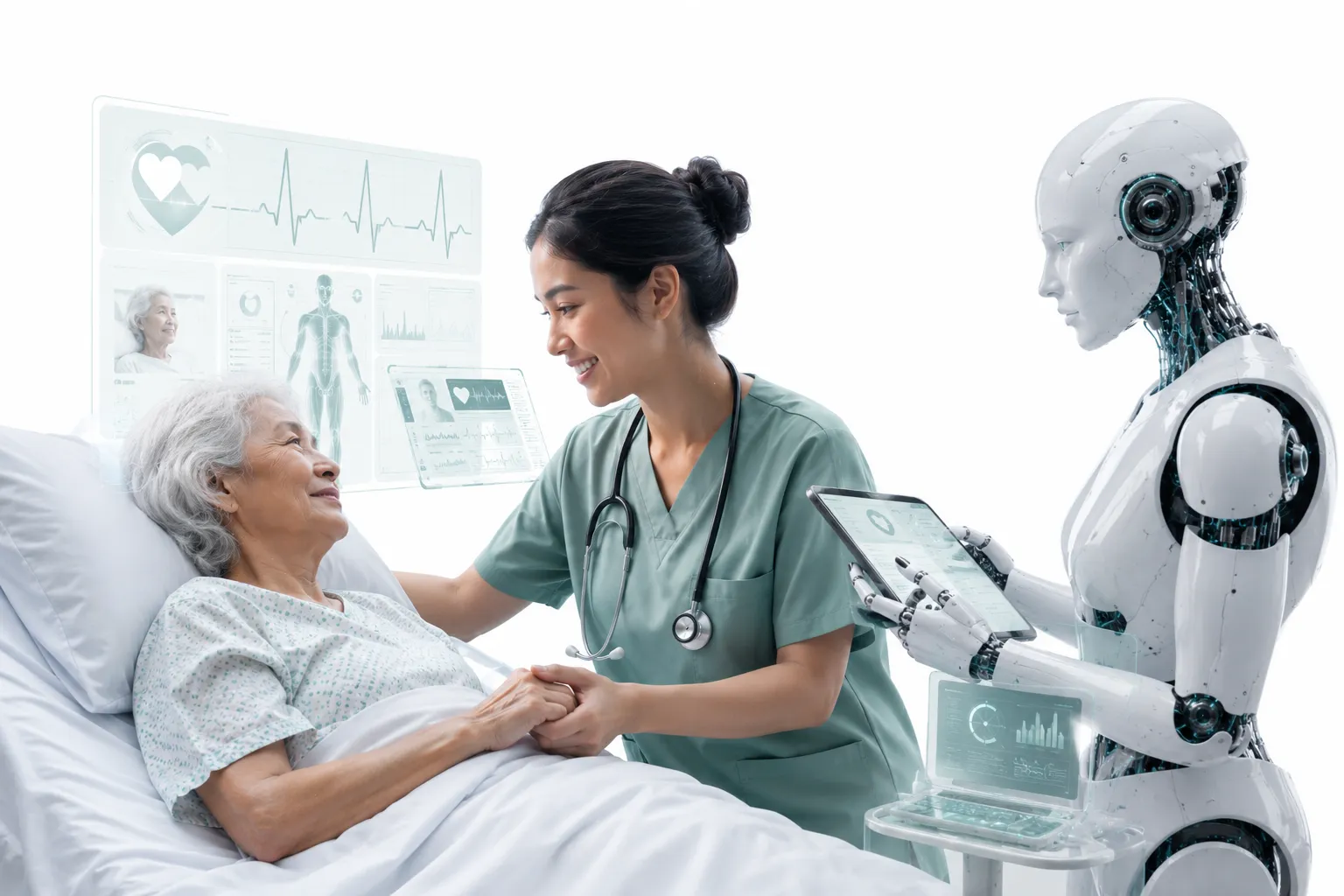
AI can detect a cancer that a human misses. It can read a scan with superhuman accuracy. It can predict outcomes with precision. But AI cannot tell a patient they have cancer and sit with their tears. AI cannot answer 'Am I going to die?' with compassion. AI cannot hold a hand. AI diagnoses. Doctors heal. That difference is everything. Master AI tools. But never forget: the heart of medicine is human.
AI Capabilities
What AI Can Do in Medicine Today
AI excels at pattern recognition and data analysis. These are diagnostic tasks.
RADIOLOGY: AI detects cancers, fractures, and abnormalities on X rays, CT scans, and MRIs. Accuracy matches or exceeds human radiologists. AI reduces false negatives by 30 to 40 percent.
PATHOLOGY: AI analyzes tissue slides for cancer cells. It identifies patterns humans miss. It quantifies biomarkers automatically.
DERMATOLOGY: AI diagnoses skin cancer from images. Accuracy matches dermatologists for common conditions.
OPHTHALMOLOGY: AI detects diabetic retinopathy and macular degeneration from retinal scans. It is deployed in primary care settings.
CARDIOLOGY: AI interprets EKGs and echocardiograms. It predicts heart failure and arrhythmias.
PREDICTION: AI predicts patient deterioration, readmission risk, and length of stay from electronic health records.
Human Advantage
What AI Cannot Do in Medicine
The human elements of medicine remain AI proof.
DELIVER BAD NEWS: AI cannot tell a patient they have cancer with compassion, sit with their grief, or answer the question 'How long do I have?'
PERFORM PROCEDURES: AI cannot perform surgery, deliver a baby, stitch a wound, or intubate a patient. Physical procedures require human hands.
PROVIDE EMPATHY: AI cannot understand a patient's fear, hold their hand, or offer genuine comfort.
BUILD TRUST: Patients trust human doctors with their lives. Trust requires relationship, time, and human connection. AI cannot build trust.
INTEGRATE DATA WITH CONTEXT: AI knows the numbers. It does not know the patient's life, values, fears, or family. Integration requires human judgment.
ADVOCATE FOR PATIENTS: AI cannot fight insurance companies, coordinate complex care, or advocate for a patient's needs.
Different Specialties, Different Fates
How AI Affects Different Medical Specialties
Your risk depends on your specialty.
RADIOLOGY: High risk. AI excels at image interpretation. Expect 30 to 50 percent reduction in radiologist roles by 2030. Radiologists will shift to interventional procedures and AI supervision.
PATHOLOGY: High risk. AI excels at slide analysis. Expect 30 to 50 percent reduction. Pathologists will focus on complex cases and molecular pathology.
DERMATOLOGY: Medium to high risk. AI matches human accuracy for common conditions. Expect 20 to 40 percent reduction. Dermatologists will focus on complex cases and procedures.
PRIMARY CARE: Low to medium risk. AI will handle routine diagnosis. Doctors will focus on communication, empathy, and care coordination. Roles transform but do not disappear.
EMERGENCY MEDICINE: Low to medium risk. AI assists with triage and diagnosis. But emergency medicine requires procedures, rapid decisions, and communication. Relatively safe.
SURGERY: Very low risk. Physical procedures require human dexterity. AI assists (robot assisted surgery) but does not replace. Surgeons are safe.
PSYCHIATRY: Very low risk. Mental health care requires empathy, trust, and human connection. AI cannot replace therapists. Psychiatry is highly AI proof.
PEDIATRICS: Low risk. Children require human connection. Parents trust human pediatricians. Safe.
High confidence
What Medical Leaders Say
AI will transform medicine but not replace most doctors. Diagnostic specialties face significant risk. Procedural and communication heavy specialties are safe. The future doctor will be AI augmented, not AI replaced. Human connection, empathy, and trust remain uniquely human.
- Severity of radiologist reduction (20 percent vs 60 percent)
- Role of AI in primary care
- Patient acceptance of AI diagnosis
Analogy
The GPS for Medicine
AI is GPS for doctors. It tells them what is wrong. It suggests treatments. It predicts outcomes. But it does not deliver the news. It does not hold the hand. It does not build trust. The doctor drives the car. The doctor provides the human connection. GPS did not replace drivers. AI will not replace doctors who provide care, not just diagnosis.
Survival Guide
How to Survive as a Medical Professional
CHOOSE YOUR SPECIALTY WISELY: Avoid pure diagnostic fields like radiology and pathology unless you plan to do interventional work. Choose procedures, communication, or complex care. LEARN AI TOOLS: Master AI diagnostic tools. Use them to work faster and better. FOCUS ON HUMAN SKILLS: Develop empathy, communication, and trust building. These are AI proof. MOVE TOWARD PROCEDURES: Surgery, endoscopy, and other physical procedures are safe. SPECIALIZE IN COMPLEX CARE: Rare diseases, complex cases, and chronic disease management are less automatable.
The worst response is ignoring AI. Every doctor will use AI in 5 years. Start now.FAQ
Common Questions
Will AI replace radiologists?
Partially. Expect 30 to 50 percent reduction in radiologist roles by 2030. AI handles routine reads. Radiologists will focus on complex cases and interventional procedures.
Is surgery safe from AI?
Yes. Physical procedures require human dexterity and judgment. Robot assisted surgery is augmentation, not replacement. Surgeons are safe.
Should I become a radiologist in 2025?
Only if you plan to do interventional radiology or specialize in complex cases. Pure diagnostic radiology is at high risk.
Can AI replace primary care doctors?
No. Primary care requires communication, empathy, and care coordination. AI will handle routine diagnosis, but doctors remain essential.
Sources
References
- Nature Medicine AI vs RadiologistsNature Medicine
- FDA AI Medical Device ApprovalsFDA
- AMA AI and the Future of MedicineAmerican Medical Association
Question journey
If this question matters, read these next
If you are worried about AI replacing jobs, most readers continue through this path.