Environmental Impact
Is Generative AI Bad for the Environment?
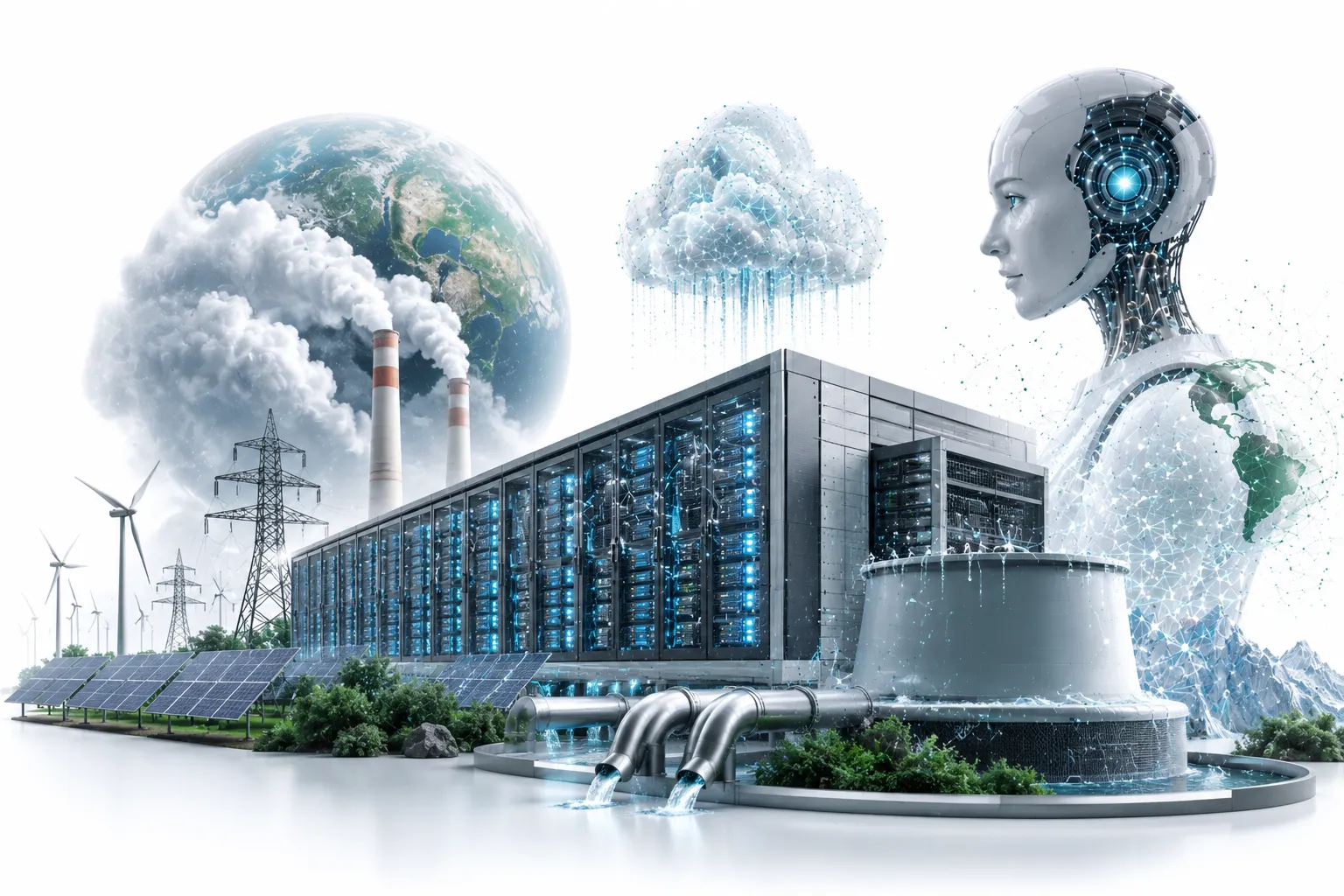
Every ChatGPT query, every DALL-E image, every Midjourney prompt has a cost—energy, water, carbon. Generative AI is not clean. Here's the truth.
Yes—generative AI is bad for the environment. Training models consumes massive energy (hundreds of MWh) and emits hundreds of tons of CO2 (5+ cars' lifetime). Inference (using the models) is worse: billions of daily queries multiply a small per-query footprint into a massive total. Generative AI also consumes billions of gallons of water for cooling. ChatGPT alone may use 500ml of water per 20-50 queries. The problem is growing 30-40% annually. Generative AI is an environmental problem.
Generative AI Is Energy-Intensive
Training large models uses as much electricity as 100+ homes for a year. Inference (daily use) adds up across billions of queries.
Image Generation Is Worse
Generating an image with DALL-E or Midjourney uses 5-10x more energy than a text query. Visual AI has a bigger footprint.
The Problem Is Scaling
Generative AI adoption is exploding. Energy and water use growing 40-50% annually. Without change, this is unsustainable.
2025 State
Generative AI's Environmental Footprint (2025)
Generative AI is already a significant environmental concern—and growing rapidly.
- 100M+ daily ChatGPT users generating billions of queries
- Water per ChatGPT query: 10-25ml (500ml per 20-50 queries)
- Image generation (DALL-E, Midjourney) uses 5-10x energy of text
- Training GPT-4 estimated 5-10x GPT-3's footprint
- Generative AI energy demand growing 40-50% annually
- Projected AI water use by 2027: 6.6 billion cubic meters
Energy
Why Generative AI Uses So Much Energy
Both training and inference are energy-intensive.
- 01
Training: One-Time Massive Energy
Training a large generative model involves processing billions of parameters through trillions of calculations. GPT-3's training used 1,300+ MWh—equivalent to 100+ US homes for a year. GPT-4 likely used 5-10x that.
Training a generative AI is like building a car factory. Huge upfront energy cost. Then each car (query) costs less. - 02
Inference: Small per Query, Massive Total
Each ChatGPT query uses about 0.001 kWh—tiny. But multiply by 100 million daily users (each doing dozens of queries) = 10+ million kWh daily. That's 3.6+ billion kWh annually—equivalent to a small country.
Each plastic bottle is small. Billions of plastic bottles are an environmental disaster. Same with AI queries. - 03
Image Generation: Much Worse
Generating an image with DALL-E or Midjourney uses 5-10x more energy than a text query. High-resolution, multi-step generation is even worse. Popular models with millions of users add up fast.
Text AI is a bicycle. Image AI is an SUV. Both travel. One uses much more fuel.
Evidence
What Research Shows
Studies on generative AI's environmental impact:
ChatGPT uses 500ml water per 20-50 queries
Scientific Study
Training GPT-3 emitted 500+ tons CO2
Scientific Study
Image generation 5-10x text energy
Scientific Study
Efficiency improving 2x every 2 years
Industry Data
Renewable energy can mitigate
Expert View
Comparison
Environmental Impact: Generative AI vs Everyday Activities
Putting generative AI's footprint in perspective
| Activity | Energy | Water | CO2 |
|---|---|---|---|
| 1 ChatGPT query | 0.001 kWh | 10-25ml | 0.5-1g |
| 1 DALL-E image | 0.005-0.01 kWh | 50-250ml | 2.5-10g |
| 1 Google search | 0.0003 kWh | 2ml | 0.2g |
| 1 hour Netflix | 0.8 kWh | 1-2L | 400g |
| 1 car mile | 0.3 kWh | N/A | 400g |
| Training GPT-3 | 1,300 MWh | 700,000L | 500+ tons |
Reality Check
What People Get Wrong About Generative AI and the Environment
False. Data centers use real energy and water. The cloud has a real footprint.
Individual use matters collectively. Billions of small footprints = massive total.
Many do—but not all. And renewable energy isn't zero-impact (mining, land use).
Efficiency helps. But Jevons paradox: efficiency often increases consumption. Generative AI will likely grow faster than efficiency gains.
Future Outlook
Generative AI and the Environment in 2035
By 2028-2030, expect efficiency improvements (5-10x per watt). More renewable-powered data centers. But generative AI adoption likely outpaces efficiency—footprint grows.
By 2035, generative AI's environmental impact will be either a solved problem (efficiency + renewables) or a major crisis. The outcome depends on choices made today.
Wild card: What if generative AI itself optimizes its own efficiency? AI could discover more efficient architectures, cooling methods, or energy sources. AI may be both problem and solution. But we can't rely on future solutions to fix current problems.
Key Takeaways
What Everyone Should Know About Generative AI and the Environment
- Yes—generative AI is bad for the environment.
- Training one model = 5+ cars' lifetime CO2.
- ChatGPT may use 500ml water per 20-50 queries.
- Image generation (DALL-E, Midjourney) uses 5-10x more energy than text.
- Billions of daily queries multiply small per-query footprints into massive totals.
- Generative AI energy use growing 40-50% annually.
- Solutions exist: efficiency, renewables, responsible use. Demand them.
The Scale Problem: Billions of Queries
One ChatGPT query is tiny. One DALL-E image is small. But 100 million daily users, each doing dozens of queries, each generating multiple images—the total is massive. Generative AI's harm is not per query. It's total multiplied by scale. We're generating billions of queries daily—and growing 40-50% annually. The cumulative impact is staggering. This is the hidden crisis of generative AI.
The Pixel Has a Weight
Generative AI feels weightless. Just pixels. Just text. But every pixel has a weight—in energy, water, and carbon. The image you generate consumes electricity. The ChatGPT query drinks water. The DALL-E prompt emits CO2. Generative AI is not virtual. It's very, very physical. Use it. Enjoy it. But never forget: the pixel has a weight. And that weight is growing.
The Verdict
Is Generative AI Bad for the Environment?
Generative AI has a significant and growing environmental footprint. Training large models consumes massive energy (hundreds of MWh) and emits hundreds of tons of CO2. Inference (using the models) is worse: billions of daily queries multiply a small per-query footprint into a massive total. Image generation is 5-10x more energy-intensive than text. Generative AI also consumes billions of gallons of water for cooling. The problem is growing 40-50% annually. Generative AI is an environmental problem that requires urgent attention.
The Thirsty AI
Generative AI Drinks Billions of Gallons
Data centers need water for cooling. Generative AI is making them thirstier.
WATER PER CHATGPT QUERY: Research estimates 500ml of water per 20-50 ChatGPT queries—about a bottle of water. With 100 million daily users, that's billions of liters daily.
TRAINING'S WATER FOOTPRINT: Training GPT-3 consumed 700,000 liters of fresh water. Training GPT-4 likely used millions.
LOCATION MATTERS: Data centers often locate in water-scarce regions (California, Arizona, Spain). Generative AI competes with agriculture and residential use for limited water.
THE GROWTH PROBLEM: By 2027, global AI water use projected at 6.6 billion cubic meters—equivalent to Denmark's total annual consumption. Generative AI is a major driver.
The Climate Impact
Generative AI's Carbon Footprint
Energy use translates to carbon emissions—depending on electricity source.
TRAINING EMISSIONS: Training GPT-3 emitted 500+ tons CO2—equivalent to 5 cars over their lifetimes. GPT-4 likely 5-10x that. Training one model = flying 1,000+ New York to London.
INFERENCE EMISSIONS: Daily ChatGPT use may emit 1,000+ tons CO2 per day (depending on energy mix). That's 365,000+ tons annually—equivalent to 70,000 cars.
IMAGE GENERATION: Generating images is 5-10x worse. Popular image models with millions of users add significant emissions.
ENERGY MIX MATTERS: Data center in Norway (hydropower) = near-zero emissions. Data center in West Virginia (coal) = high emissions. Many AI companies use renewable energy—but not all.
Not All AI Is Equal
Text vs Image: A Footprint Comparison
Generating images is far more harmful than generating text.
ENERGY PER TEXT QUERY: ~0.001 kWh (ChatGPT). Tiny. But multiplied by billions.
ENERGY PER IMAGE QUERY: ~0.005-0.01 kWh (DALL-E, Midjourney). 5-10x text. High-resolution, multi-step generation is higher.
WATER PER TEXT QUERY: ~10-25ml. Small but adds up.
WATER PER IMAGE QUERY: ~50-250ml. 5-10x text.
CARBON PER TEXT QUERY: ~0.5-1g CO2.
CARBON PER IMAGE QUERY: ~2.5-10g CO2.
THE BOTTOM LINE: Use text AI when possible. Save image AI for when visuals truly matter.
High confidence
What Environmental Scientists and AI Researchers Say
Generative AI has a significant and growing environmental footprint. Text AI has small per-query cost but massive scale. Image AI is 5-10x worse. Training is particularly damaging. Without efficiency improvements, renewable energy, and sustainable practices, generative AI will become a major climate concern.
- Severity of the problem (some say crisis, some say manageable)
- Whether efficiency can keep pace with growth
- Responsibility of AI companies vs individual users
Analogy
The Plastic Bottle of AI
But billions of plastic bottles are an environmental disaster. Generative AI is the plastic bottle of technology. One query seems harmless. But billions of queries daily are an environmental disaster. The solution isn't to ban generative AI—it's to use it responsibly. Don't generate an image when text will do. Don't ask ChatGPT for trivial answers. Every query has a cost. Use generative AI like you use plastic—sparingly, responsibly, and with recycling (efficiency, renewables).
Solutions
What If We Want to Reduce Generative AI's Environmental Impact?
Individual: 1) Use generative AI only when necessary. 2) Prefer text over images. 3) Use smaller, more efficient models. 4) Don't generate multiple versions unnecessarily. 5) Support companies committed to renewable energy. Collective: 1) Efficiency standards for AI models. 2) Renewable energy mandates for data centers. 3) Carbon/water disclosure requirements. 4) Carbon taxes on AI generation. 5) Research into green AI.
Individual actions help but systemic change is essential. Demand transparency and regulation.Scenarios
Three Environmental Scenarios for Generative AI
Optimistic: Green Generative AI
10x efficiency gains. 100% renewable energy for data centers. Users adopt responsibly. Footprint stabilizes.
Realistic: Growing Problem
Efficiency gains partially offset growth. Footprint grows 2-3x by 2030. Significant but not catastrophic.
Pessimistic: Climate Disaster
Generative AI adoption explodes. Efficiency gains minimal. Fossil-fuel-powered data centers. AI becomes 5-10% of global electricity use.
FAQ
Common Questions
Is ChatGPT bad for the environment?
Yes—at scale. One query has small impact. Billions of daily queries add up to significant energy and water use.
Is DALL-E worse for the environment than ChatGPT?
Yes—5-10x more energy per query. Use text when possible. Save images for when they truly matter.
Can generative AI be environmentally friendly?
Yes—with efficiency improvements, renewable energy, and responsible use. Some companies are working on 'green AI.'
Should I stop using generative AI for the environment?
No—but use responsibly. Don't generate unnecessary images. Don't ask trivial questions. Support companies committed to sustainability.
Sources
References
Question journey
If this question matters, read these next
Most readers use this path to move from the current question into the wider knowledge graph.