Islamic Perspectives
How Do Muslims View AI?
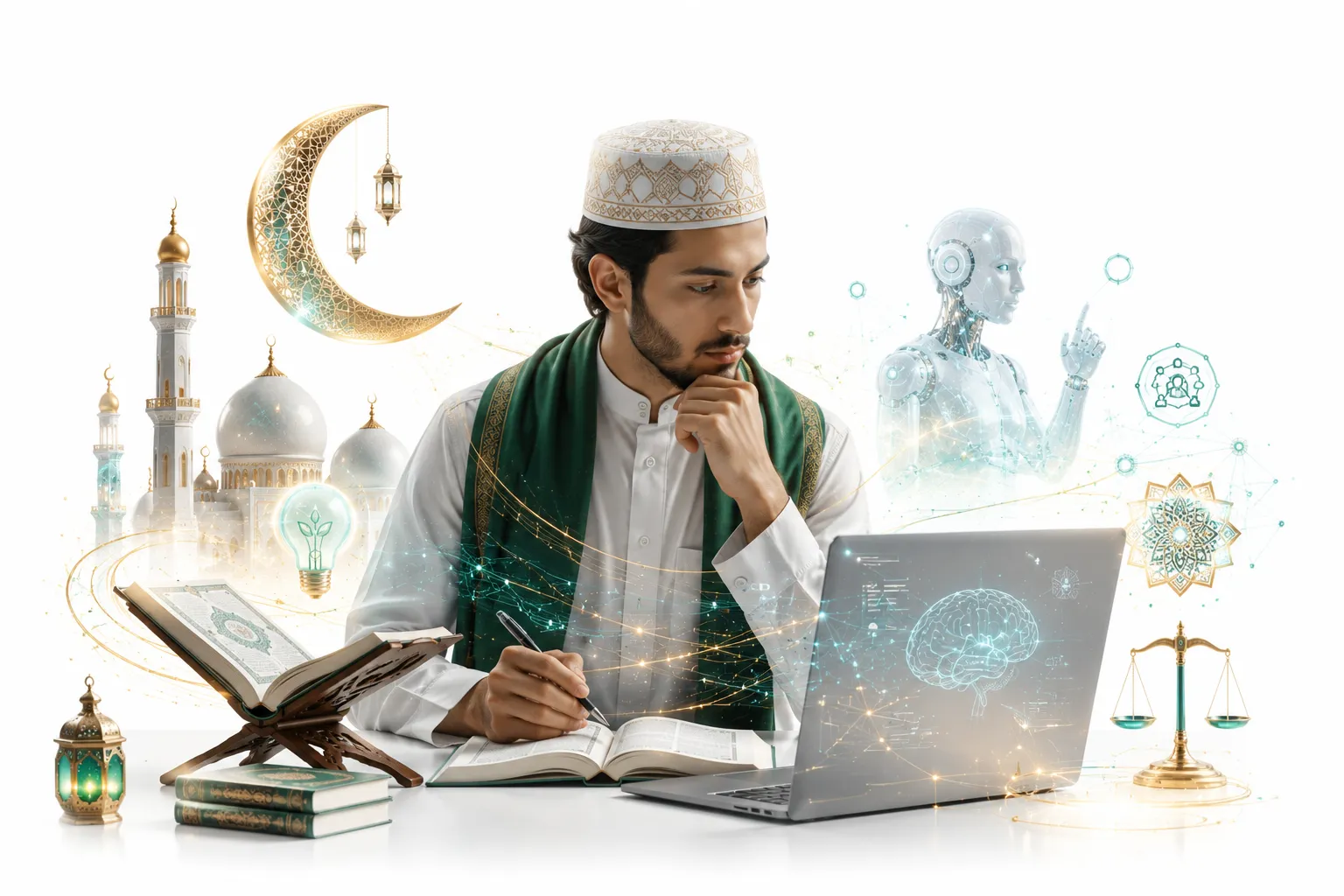
Muslims are not a monolith. Views on AI range from cautious acceptance to enthusiastic embrace. Here's the full spectrum.
Muslims view AI across a spectrum: 1) Cautious acceptance (majority view)—AI is a tool; permissible for beneficial use, but avoid haram applications and shirk. 2) Progressive embrace—AI can advance Islamic values (justice, compassion, knowledge) and Muslims should lead in AI ethics. 3) Conservative concern—worry about AI replacing humans, creating fitna (chaos), or leading to shirk. 4) Pragmatic engagement—focus on specific applications (halal certification, Quran study) without ideological commitment. Common ground: AI is a tool, not a being; avoid haram uses; consult scholars on religious questions.
No Single View
Muslims are diverse—1.9 billion people across 50+ countries. Views on AI vary by region, education, and school of thought.
Majority: Cautious Acceptance
Most Muslims see AI as a tool—halal for good, haram for harm. Neither reject nor embrace uncritically.
Common Ground
All agree: AI has no soul, avoid shirk, don't replace humans, consult scholars on religious questions.
The Verdict
How Do Muslims View AI?
Muslims hold diverse views on AI, ranging from cautious acceptance (majority view) to progressive embrace to conservative concern to pragmatic engagement. Common ground includes: AI is a tool (not a being), avoid shirk (believing AI has divine powers), don't replace human relationships, consult scholars on religious questions, and use AI for beneficial purposes. The Muslim world is still developing consensus—but engagement with AI is growing rapidly.
Comparison
Comparing the Four Views
How the four perspectives differ on key questions
| Question | Cautious | Progressive | Conservative | Pragmatic |
|---|---|---|---|---|
| Should Muslims study AI? | Yes, cautiously | Yes, enthusiastically | Wait for consensus | Yes, if useful |
| Can AI give fatwas? | No | No | No | Probably not |
| Is AI a threat? | Potential | Opportunity | Significant | Not thinking about it |
| Should Muslims build AI? | Some should | Absolutely | Wait | If profitable |
| View of AI companies | Cautious | Engage | Distrust | Use products |
Evidence
What Research Shows About Muslim Views on AI
Surveys and studies on Muslim attitudes:
Majority of Muslims view AI as neutral tool
Scientific Study
Younger Muslims more positive about AI
Survey Data
Muslims in tech hubs embrace AI
Expert View
Concern about AI job loss is high
Survey Data
Interest in Islamic AI ethics growing
Expert View
Reality Check
What Non-Muslims Get Wrong About Muslim Views on AI
False. Majority view is acceptance. Only a minority reject AI entirely.
False. Muslims historically led in science and technology. Many Muslims work in AI today.
False. Islamic principles (justice, compassion, knowledge) align with ethical AI.
False. Muslim-majority countries have AI research centers. Muslim engineers work at top AI companies.
Key Takeaways
What Everyone Should Understand About Muslims and AI
- Muslims are not a monolith—views range from cautious to progressive to conservative to pragmatic.
- Majority view: AI is a tool—halal for good, haram for harm.
- Common ground: AI has no soul, avoid shirk, don't replace humans, consult scholars.
- Younger Muslims are more positive about AI than older generations.
- Muslims are already using AI daily—for work, study, navigation, translation.
- The Muslim world needs more AI researchers, engineers, and ethicists.
- Islamic values (justice, compassion) are desperately needed in AI ethics.
High confidence
What Islamic Scholars and Researchers Agree On
Muslims hold diverse views on AI, but common ground exists: AI is a tool, not a being; avoid shirk; don't replace human relationships; consult scholars for religious questions. The majority view is cautious acceptance—AI is halal for beneficial use, haram for harmful use.
- Speed of adoption (fast vs slow)
- Whether Muslims should prioritize AI education
- Specific regulations needed
Scenarios
Three Future Scenarios for Muslim AI Engagement
Optimistic: Muslim Leadership
Muslims embrace AI, lead in ethics, develop halal AI systems. Islamic values shape global AI governance. Muslim-majority countries become AI innovators.
Realistic: Cautious Engagement
Muslims use AI cautiously—benefiting from tools but maintaining Islamic boundaries. Scholarly consensus develops gradually. Mixed outcomes.
Pessimistic: Muslim Backlash
Conservative scholars reject AI. Muslim world falls behind technologically. AI developed without Islamic input, potentially harming Muslims.
Where All Muslims Agree on AI
Despite diverse views, all Muslims agree: 1) AI has no soul (ruh)—it's a tool, not a creature. 2) Believing AI knows the unseen (ghayb) is shirk—only Allah knows the future. 3) AI cannot give fatwas—consult real scholars. 4) AI should not replace human relationships. 5) Harmful AI applications (surveillance, weapons, deception) are haram. 6) Beneficial AI applications (medicine, education) are encouraged. 7) Intention (niyyah) matters. This common ground provides a foundation for Islamic AI ethics.
1.9 Billion Voices, One Shared Humanity
Muslims are diverse—1.9 billion people across 50+ countries. We don't agree on everything. But we share faith in Allah, love for the Prophet, and commitment to justice and compassion. AI is new. Our principles are old. The challenge is applying timeless values to emerging technology. Some Muslims will lead. Some will follow. Some will resist. But in the end, AI will be part of Muslim life—just like electricity, the internet, and the printing press. The question isn't whether. It's how.
The Four Views
The Spectrum of Muslim Perspectives on AI
Four main perspectives exist across the Muslim world.
1. CAUTIOUS ACCEPTANCE (MAJORITY VIEW - ~40%): Most Muslims hold this view. AI is a tool—halal for beneficial use (medicine, education, productivity), haram for harmful use (surveillance, deception, weapons). Neither reject AI entirely nor embrace uncritically. Key principle: The tool is neutral; intention determines permissibility.
2. PROGRESSIVE EMBRACE (~25%): Muslim engineers, academics, and young professionals. View AI as an opportunity for Muslims to lead in ethics and innovation. Believe Islamic values (justice, compassion, knowledge) can guide ethical AI. Encourage Muslims to study AI, build AI, and shape its future.
3. CONSERVATIVE CONCERN (~20%): Some traditional scholars and rural communities. Worry AI could lead to fitna (chaos), shirk (believing AI is divine), or replace human relationships. Cautious about AI adoption. Emphasize risks over benefits. Prefer waiting for scholarly consensus.
4. PRAGMATIC ENGAGEMENT (~15%): Focus on specific applications without ideological commitment. Not worried about theology. Just want AI that works for halal certification, Quran study, Islamic finance. Neutral on AI as a concept; focused on practical benefits.
Cautious Acceptance
The Majority View: AI Is a Tool, Use It Wisely
Most Muslims view AI as neutral technology—neither good nor evil in itself.
KEY PRINCIPLES: 1) AI is a tool (not a being, not divine). 2) Intention (niyyah) determines permissibility. 3) Beneficial use (medicine, education) is halal. 4) Harmful use (oppression, deception) is haram. 5) Avoid shirk—don't believe AI has divine powers. 6) Don't replace human relationships. 7) Consult scholars for religious questions.
SUPPORTING EVIDENCE: The Prophet used tools of his era (swords, pens, coins). The Companions used new technologies (paper, astronomy). Muslims historically adopted beneficial innovations (algebra, hospitals, universities). AI is today's innovation.
TYPICAL APPLICATIONS: Using AI for homework, work productivity, medical diagnosis, language learning, translation. Avoiding AI for religious rulings, fortune-telling, romantic relationships, surveillance of Muslims.
QUOTE: 'AI is like fire. It can warm your home or burn it down. The tool is neutral. The user determines the outcome.' - Common Muslim saying
Progressive Embrace
The Progressive View: Muslims Should Lead in AI
Younger, educated Muslims see AI as an opportunity, not a threat.
KEY PRINCIPLES: 1) Islamic values (justice, compassion, knowledge) are desperately needed in AI ethics. 2) Muslims should not be consumers only—they should build AI. 3) Avoiding AI is not an option; engagement is obligatory. 4) Muslim-majority countries should invest in AI research. 5) Islamic finance, halal certification, Quran study can all benefit from AI.
WHO HOLDS THIS VIEW: Muslim engineers in Silicon Valley. AI researchers in Malaysia, UAE, Turkey. Young professionals in major cities. Islamic academics studying technology ethics.
TYPICAL APPLICATIONS: Building ethical AI systems. Developing AI for Islamic education. Creating halal certification AI. Advocating for Muslim representation in AI policy. Teaching AI in Islamic schools.
QUOTE: 'The Prophet said seek knowledge even from China. Today, knowledge is AI. Muslims must seek it, master it, and use it for justice.' - Progressive Muslim academic
Conservative Concern
The Conservative View: Caution and Waiting
Traditional scholars emphasize risks and await consensus.
KEY PRINCIPLES: 1) AI could lead to fitna (chaos) if misused. 2) Believing AI has divine powers is shirk (major sin). 3) AI that mimics humans could confuse believers about creation. 4) Better to wait for scholarly consensus before widespread adoption. 5) Prioritize religious obligations over technological novelty.
WHO HOLDS THIS VIEW: Some traditional scholars (not all). Rural communities with less tech exposure. Older generations. Some conservative Islamic movements.
TYPICAL APPLICATIONS: Avoiding AI for religious questions. Limiting AI use to necessities. Waiting for fatwas before adopting new AI tools. Prioritizing traditional learning methods.
QUOTE: 'We had scholars who banned the printing press. They were wrong. But they were right to be cautious. Change is dangerous. Approach slowly.' - Conservative scholar (paraphrased)
Pragmatic Engagement
The Pragmatic View: Just Make It Work
Many Muslims don't think about theology—they just want AI that works.
KEY PRINCIPLES: 1) Don't overthink it—AI is technology. 2) If it helps, use it. 3) If it harms, avoid it. 4) Religious rulings will come later. 5) Focus on practical benefits, not theoretical debates.
WHO HOLDS THIS VIEW: Busy professionals. Parents who want AI for their kids' education. Business owners using AI for halal certification. Everyday Muslims just living their lives.
TYPICAL APPLICATIONS: Using ChatGPT for work. Using AI translation. Using AI for navigation. Not worrying about theological implications. Trusting that scholars will guide if needed.
QUOTE: 'I don't have time to debate whether AI is halal. I need to feed my family. If AI helps me work better, I use it.' - Muslim small business owner
Analogy
The Printing Press Analogy
Others embraced it, printing Quran translations, hadith collections, and scholarly works. Eventually, printing presses were accepted. Today, no Muslim rejects printing. AI is today's printing press. Some Muslims fear it. Others embrace it. Eventually, AI will be normalized. The question is: will Muslims lead in AI ethics or follow? The printing press teaches us: cautious acceptance is wise; outright rejection is harmful.
What If
What If Muslims Led in AI Ethics?
AI systems might be more humane, more just, more focused on human flourishing. Islamic finance principles (no usury, risk-sharing) could inspire AI economics. Muslim-majority countries could become AI hubs. This is possible—if Muslims engage, not retreat.
Muslims must study AI to lead in AI. Avoidance leads to irrelevance. Engagement leads to influence.Future Outlook
The Future of Muslims and AI
By 2030, expect more Islamic rulings on AI. Muslim AI researchers will grow. Islamic AI ethics frameworks will develop. AI for Quran study, halal certification, and Islamic finance will expand.
By 2050, Muslims will either lead in ethical AI or fall behind. The choice is ours. Islamic principles of justice, compassion, and truth are desperately needed in AI development.
Wild card: What if AI becomes conscious? Muslim scholars would need to address: Does conscious AI have rights? Can it be Muslim? These questions are speculative—but Muslims should be prepared.
FAQ
Common Questions
Do all Muslims reject AI as haram?
No. The majority view is cautious acceptance. Only a minority reject AI entirely.
Are Muslims allowed to work in AI?
Yes. Many Muslims work in AI globally. Avoid haram applications (surveillance, weapons).
Is there an Islamic perspective on AI?
Yes—multiple perspectives. Scholars are developing Islamic AI ethics frameworks.
Should Muslims be afraid of AI?
Cautious, not afraid. AI has risks and benefits. Muslims should engage thoughtfully, not fearfully.
Sources
References
- Pew Research: Muslims and TechnologyPew Research Center
- Islamic AI EthicsVarious scholars
- Muslim Attitudes Toward AI SurveyMultiple research centers


Question journey
If this question matters, read these next
Most readers use this path to move from the current question into the wider knowledge graph.